In 2024, based on a Memorandum of Understanding between Bears in Mind, Stiftung für Bären, and the National Heritage Institute, a research project was launched to investigate public perceptions of bear keeping in castle moats across the Czech Republic.
The study was conducted by Žaneta Křišťanová (Faculty of Environmental Sciences – CZU) as part of her Master’s thesis, supervised by Ing. Aleš Vorel, Ph.D., and Ing. Eva Filipczyková. MSc. Sociologists from the Polish Academy of Sciences have also been collaborating on the project.
How the Research Was Conducted
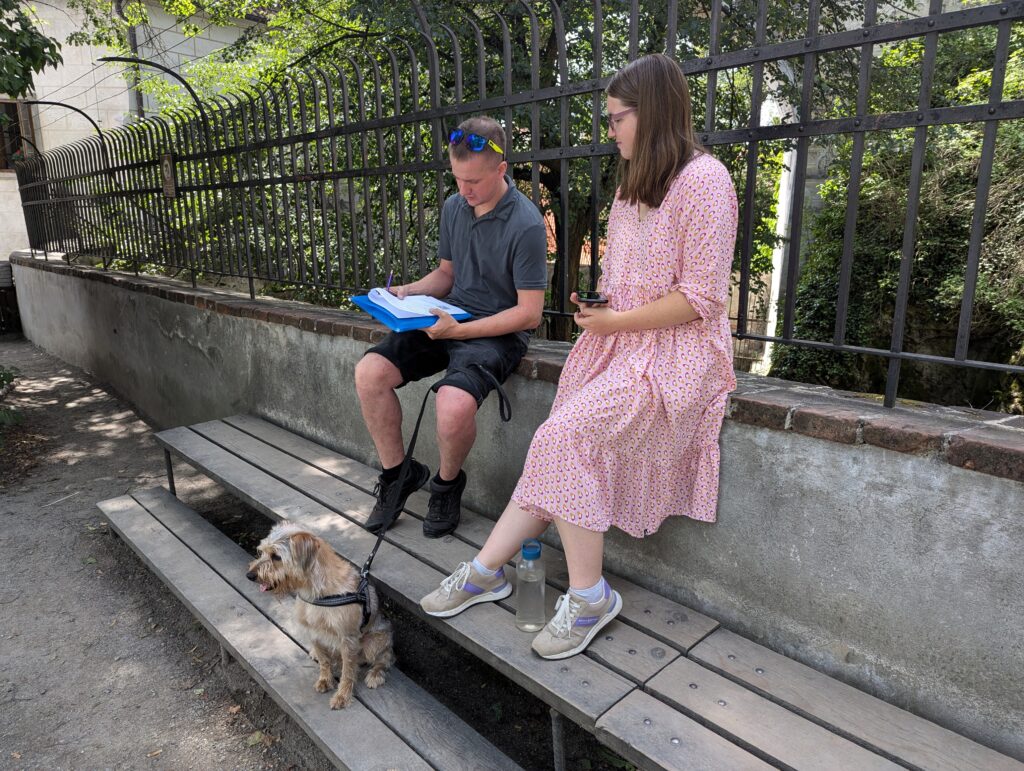
Field data were collected from June to September 2024 at all castle locations where bears (a total of seven bears of two different species) were kept at the time:
- Český Krumlov, Konopiště
- Náchod
- Točník
A total of 604 visitors aged 15 and older participated (73% Czech, 27% international). The questionnaire was completed in two parts:
- Before watching an educational video
- After watching the video, to evaluate changes in attitudes.
Key Findings
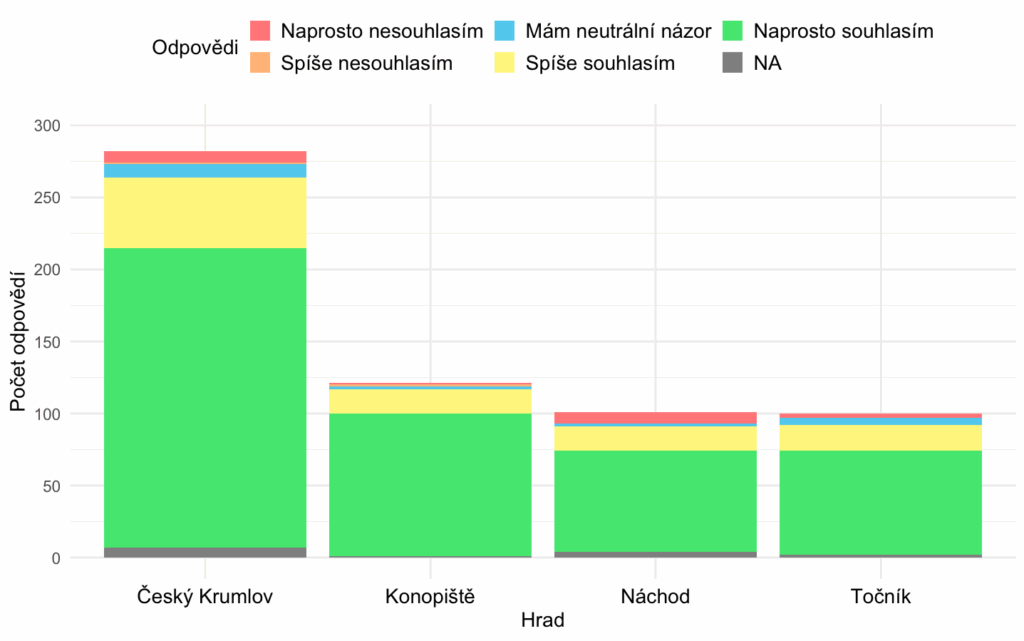
Bears Are Not the Main Reason for Visiting (see the graph below):
- 93% of visitors said they would visit the castle or chateau even without bears
- Only 7% indicated that the presence of bears was a significant motivation
Evaluation of Living Conditions – Significant Change After Watching the Video
Before the video:
- 42% (256 people) disagreed that the castle conditions were suitable
After the video:
- Disagreement rose to 71% (429 people)
- 39% (233 people) even strongly disagreed
- Agreement dropped to 13% (79 people)
Age Differences – Example of Two Groups
Age 18–25 (n = 124):
- Agreement with the statement “Keeping bears in moats is a medieval practice that should be banned”
- Before video: 50% (56 people)
- After video: 70% (86 people)
- Strong disagreement remained low (~5%)
Age 60+ (n = 77):
- Before video: agreement 29% (21 people), strong disagreement 32% (23 people)
- After video: agreement 42% (32 people), strong disagreement 13%
- The largest change was a sharp drop in opponents who had initially perceived bear keeping as a tradition
Modern Bear Parks/ Sanctuaries
- 90% of respondents (450 of 502 who answered the question) consider modern bear parks more suitable and beneficial for the bears than castle moats
Conclusions
The study shows that:
- The public is often insufficiently informed about the actual conditions of bear keeping.
- International tourists tend to evaluate the situation more critically than domestic visitors.
- Education has a significant impact on attitudes: a short video led to major changes across most demographic groups.
The data will be used by the National Heritage Institute and the BEAR HOPE project to inform future decisions on bear care in historic sites owned by the Czech state.